12 Helpful Tools for Finding and Documenting Water Damage
Restoration
4 min read
Any time you are hired to inspect a home for water damage, you will want to be well-equipped for the task. Here is a rundown of some key tools to consider using after you arrive at the job site.
1. Your Senses
Three of your five senses – sight, sound and smell – are ideal tools for detecting the presence of standing water, leaking water, or signs of water damage.
Look for pools or puddles of water on floors, particularly near walls and around floor drains and sump pumps.
Inspect for moist, damp areas on ceilings, walls and floors.
Check for discoloration on ceilings and walls, as well as other irregularities (sagging, bubbling, peeling, blistering, bubbling, cracking).
Search for signs of mold, which appears as clustered black or brown dots in its early stages.
Listen for the sound of dripping or running water.
Take note of musty, lingering odors that may indicate water leakage or water damage.
2. A Heavy-Duty Flashlight
You will need a good one for spotting corrosion on water pipes – often a sign of water damage – and for peering in any dark or shadowy spaces. Be sure to pack extra batteries as well.
3. An Acoustic Listening Device
A steady water leak will make a noticeable sound. You can use a plumber’s acoustic listening device to hear through walls and floors and try to pinpoint the source of the leak.
4. A Digital Hygrometer
This type of sensing device is used to gather a quick and accurate reading on the amount of humidity inside a room (i.e., the amount of moisture in the air within that particular space). A high reading may indicate the presence of unwanted water or moisture located somewhere in that home.
5. A Thermo-Hygrometer
A jazzed-up version of a basic hygrometer, this tool measures both the humidity of the air and the temperature of the air. So, it provides a more complete look at the environmental conditions of a room.
6. A Thermal-Imaging Camera
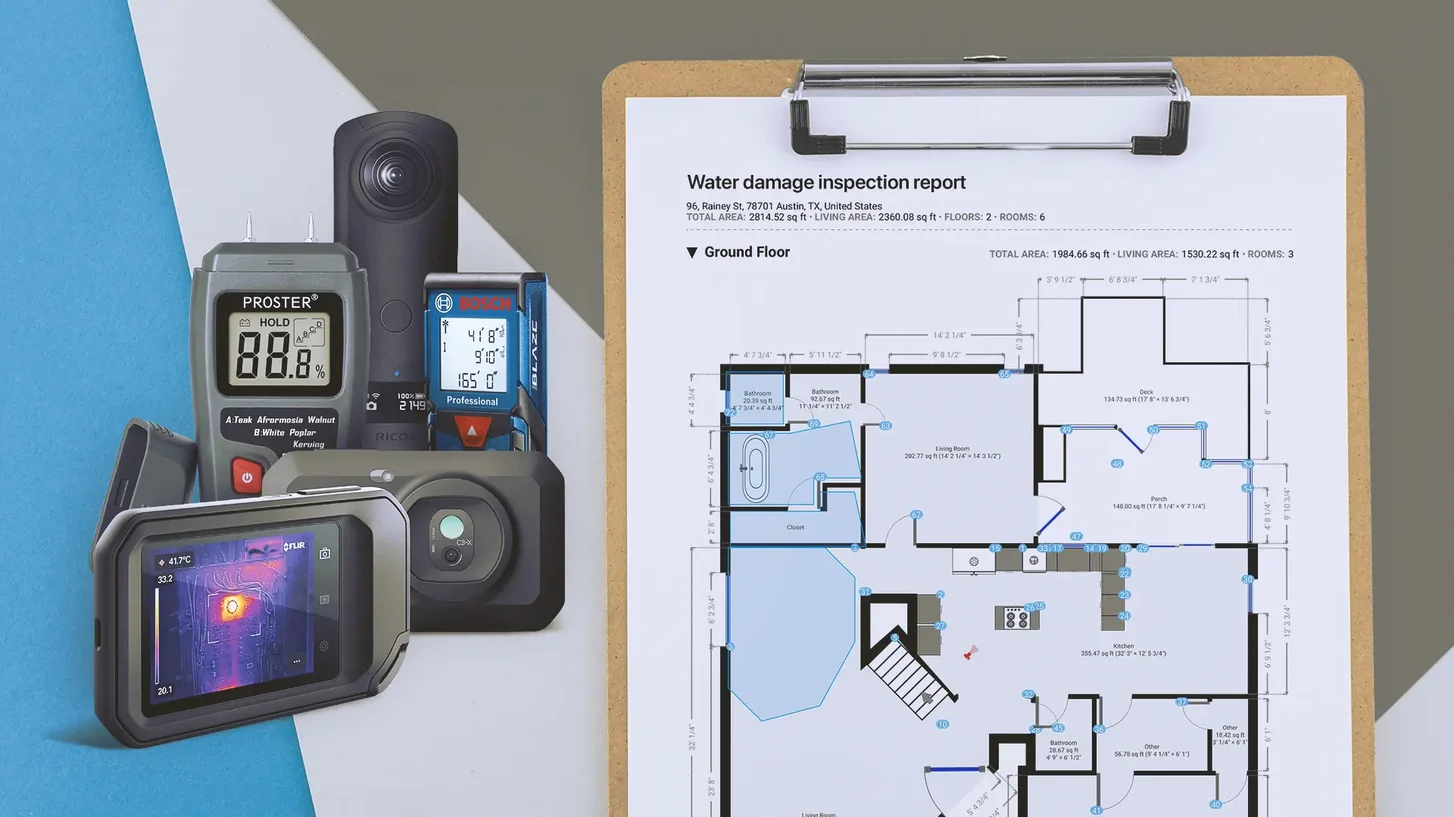
Quite different from a regular photography camera, this high-tech tool can detect something that our eyes cannot see: It is able to sense infrared energy (heat) and then convert that heat into a visual image. So, when you are inspecting a home for water damage, a thermal-image camera can be useful for detecting the difference between warm and cool areas hiding behind walls. A leaky, wet area will have a cooler temperature compared to stable, non-wet areas.
7. A Moisture Meter
A thermal-imaging camera may identify a temperature pattern that looks like moisture, but it does not verify the actual presence of water (i.e., it cannot “see” moisture in walls). That’s why you should always use a handheld moisture meter to confirm whatever your thermal-imaging camera has detected. Placed directly against a wall in several different spots, the device will help you analyze the moisture content of that wall.
8. A Video Pipe Camera
This is the perfect tool for detecting the source of a leak inside a pipe. It consists of a long, flexible fiber-optic cable that is mounted with a light and a miniature camera. It connects to a video monitor where you can see images of the pipe’s interior.
9. A Moisture Sensor
This is a long, tubular, handheld tool that has pointed sensor probes on one end. It is especially useful for determining water migration under carpet on a floor.
10. A Mold Testing Kit
This kind of kit can be used to test the presence and quantity of mold spores via surface sampling or air sampling. Mold testing is typically performed when a home is already suspected to be contaminated by mold.
11. A Mobile Floor Plan App
A floor plan app is an ideal tool for documenting water leaks and damages you find at a residential property. Using this approach offers multiple advantages:
Save Time – The app will draw a floor plan of each room automatically as you scan it with your mobile-device camera. When you have a complete floor plan that is drawn to scale, you can enhance the plan by adding room features and objects, such as furniture and appliances. Then you can add notes and markups to record your findings in a speedy fashion. Whatever you need to record, you can do so easily and instantly as you conduct your water damage inspection.
Generate Reports – A high-quality floor plan app will have built-in reporting capabilities. With this type of app, you can convert any floor plan into a detailed water damage inspection report that is shareable right from the jobsite.
Authenticate Your Findings with Photos – With the right floor plan app, you’ll be able to enhance your inspection report with photos right away. Simply take pictures with your mobile device as you move through your water damage inspection, then import those into your floor plan report. You can even add captions, if necessary, to explain the scenes shown in your pictures
Read more: What to Include in Professional Water Damage Reports
12. A Bluetooth Laser Distance Meter
You may want to pair one of these wireless devices with your floor plan app. In fact, this combination of two tools is the fastest and most accurate method for creating a floor plan sketch when you are at a residential property. Here’s how it works: Select and download a mobile floor plan app that is designed to work hand-in-hand with a Bluetooth laser distance meter. Sync your app with the distance meter. Then use both devices together to do all your measuring and mapping. If you are looking to measure and draw a room in square feet in less time, this is your best option.
It Pays to Be Prepared
Having the right tools on hand during a residential water damage assessment is exceedingly important. This will ensure that you are able to perform your job well by determining and documenting the full extent of any damage in the home.
SEE HOW YOU CAN CREATE PHOTO REPORTS QUICKLY AND EASILY
Learn how to boost your IAQ business by Marketing Inspections to Multiple Audiences.
Or read our guide on why you should be adding Indoor Air Quality Inspections to your menu of services.
Share

Silvia Corvi
Community Manager