Why and How to Manage Water Damage Restoration Remotely
Restoration
3 min read
Daily monitoring of the drying process is a standard practice in the water restoration industry. Typically, technicians are responsible for performing daily inspections at jobsites, to measure and report on moisture levels. But some restoration contractors are minimizing the need for this labor-intensive approach, thanks to newer technology that enables drying to be managed remotely.
Water-damage restoration projects require careful management of onsite equipment. Installed systems must run properly and dry effectively. But if a system experiences downtime or dries too gently, the time required to restore a property increases. That’s the leading reason why proper equipment management is so important.
But equipment management has traditionally required multiple return visits to jobsites. The process is patchy, imperfect, time-consuming and costly. For these reasons, remote management is becoming more accepted and more prevalent in the restoration industry.
You’ve probably heard about remote management, but hesitated to explore using it. So, read on to learn more about it. And find out why it might be a good investment for your water damage restoration business.
A Definition of Remote Management
Remote management is the use of smart technology to monitor and report on how well drying equipment is functioning and how effectively it is performing. Let’s look at both aspects…
Remote monitoring is primarily available in two forms:
Onsite sensors that collect relevant air-quality data, without the need for a technician visit. The sensors can track moisture and temperature levels, which may be viewed remotely in real time on a computer or mobile device).
Drying equipment (dehumidifiers, air movers, etc.) with built-in Bluetooth connectivity for remote-monitoring and control capabilities. This type of equipment further bolsters remote management. In some cases, Bluetooth beacons can be retrofitted on existing equipment to allow data readings.
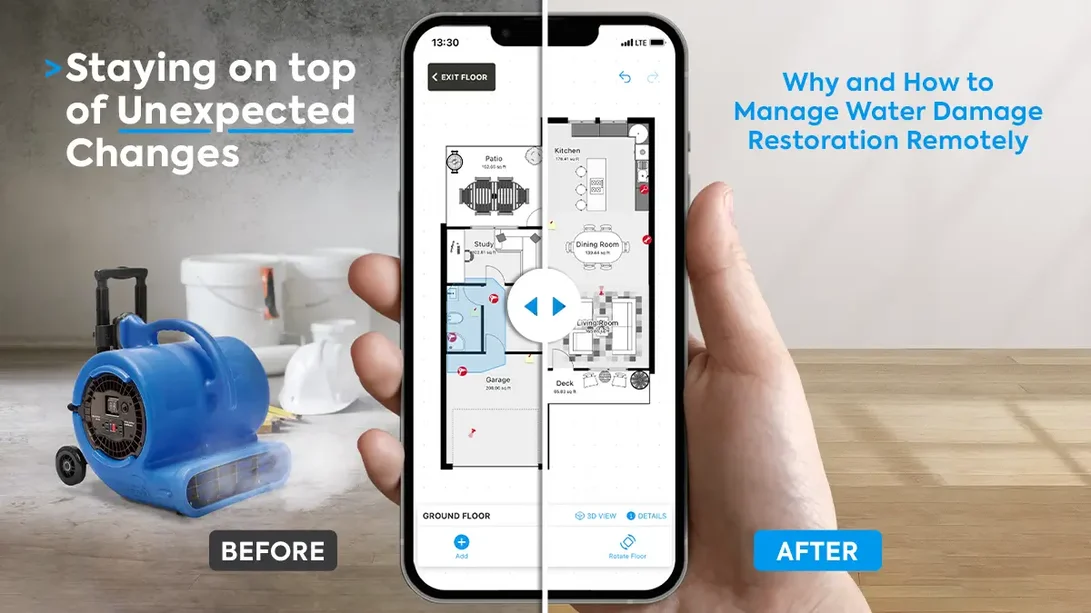
Remote reporting is a separate function, and involves using a mobile app to create and share reports and collaborate on jobs. For example, a versatile floor plan app (a form of water damage restoration software) will let you do all of the following:
Sketch each water-damaged room at a new jobsite accurately and rapidly – within minutes – for contextual visualization.
Assemble room sketches into a complete floor plan sketch, if necessary.
Attach photos of the jobsite.
Add sketch annotations and photo markups to increase understanding of the property’s condition and to visualize your drying plan.
Consolidate your sketch, annotations and photos into a professional, branded report.
Share your initial report as a baseline document (via email) before work begins.
Modify your report easily at any time by adding remote-monitoring data and other updates to substantiate your work.
Generate and share a final report to demonstrate completion of the drying job.
Why Consider Remote Management
Here are eight solid reasons for investing in remote-management technology:
Reduced Project Management Costs – Your business can reduce labor and commuting costs by avoiding wasted travel time. Technicians will no longer have to make multiple, fuel-burning trips to jobsites where drying is taking place.
Time Savings – If your technicians no longer have to make multiple trips to drying jobsites, they will be free to focus on other priorities. This can enable significant productivity gains to increase project capacity.
Round-the-Clock Readings – With remote-monitoring technology, critical readings are no longer dependent on technicians’ availability for in-person visits. Instead, real-time readings can be checked remotely on a mobile device, at any time of the day or night. You get up-to-date information whenever you want it, to gain insight on the drying progress and make more informed decisions.
Minimized Onsite Disruptions – Property owners don’t have to accommodate multiple technician visits, which can be annoying and inconvenient.
Reduction of Wasted Running Times – This helps conserve energy costs for property owners.
Quicker Resolve of Problems – Equipment underperformance or failure can be detected earlier and rectified faster.
Notifications When Equipment Is Turned Off – All too often, people will turn off equipment at night and turn it on again in the morning – or even turn it off for days at a time. This is a huge problem for restoration contractors because it interrupts and draws out the drying process. But modern remote technology allows technicians to be notified when equipment is turned off for some random reason. You can also use this type of notification to help an insurance company realize why a job took longer than planned.
Improved Reporting and Collaboration – Today’s mobile-device technology allows faster, better communication about a drying job’s progress and completion. You can share detailed PDF reports with your team and also with insurers.
All of these advantages can serve to transform your business into a more efficient and more profitable operation.

Conclusion
Managing drying projects remotely involves two aspects: remote monitoring and remote reporting. Using both together offers a wealth of benefits. So, it’s worth your while to consider adopting remote management as a business-improvement initiative – one that streamlines your water damage restoration protocol. Continue to look into it and discover what all you have to gain!
Share
Why Consider Remote Management
Conclusion

Bernd Wolfram
CPO