Understanding Water Damage Categories 2 and 3: Restoration Contractors
Restoration
4 min read

When evaluating water damage scenarios, contractors can use ‘water categorization’ (classes of water damage) to grade the degree of contamination. Here we examine the two most serious categories, as specified by the Institute of Inspection Cleaning and Restoration Certification (IICRC). Both categories are bad news for property owners, but it’s necessary to understand their distinctions.
Understanding Water Categories 2 and 3
The IICRC Reference Guide for Professional Water Damage Restoration (known as the mv) categorizes water into three groups based on the source and contamination level. Category 1 involves clean water from a sanitary source, while Categories 2 and 3 involve progressively more contaminated water.
Here are brief explanations:
IICRC S500 Category 2 water, often referred to as “gray water,” contains significant contamination. It requires a heightened level of caution, as it may contain harmful microorganisms and pollutants.
IICRC S500 Category 3 water, on the other hand, is grossly contaminated. Also known as “black water,” it necessitates even more stringent measures. Protective gear, thorough disinfection, and the removal of contaminated materials become vital.
A Closer Look at the Two Categories
Now let’s dig into the details. The IICRC S500 Standard describes Categories 2 and 3 as follows:
Category 2 water contains significant contamination and has the potential to cause discomfort or sickness if contacted or consumed by humans. Category 2 water can contain potentially unsafe levels of microorganisms or nutrients for microorganisms, as well as other organic or inorganic matter (chemical or biological). Examples of Category 2 water can include, but are not limited to: discharge from dishwashers or washing machines; overflows from washing machines; overflows from toilet bowls on the room side of the trap with some urine but no feces; seepage due to hydrostatic pressure; broken aquariums and punctured water beds.
Category 3 water is grossly contaminated and can contain pathogenic, toxigenic or other harmful agents. Examples of Category 3 water can include, but are not limited to: sewage; toilet backflows that originate from beyond the toilet trap regardless of visible content or color; all forms of flooding from seawater; ground surface water and rising water from rivers or streams; and other contaminated water entering or affecting the indoor environment, such as wind-driven rain from hurricanes, tropical storms, or other weather-related events. Such water sources may carry silt, organic matter, pesticides, heavy metals, regulated materials, or toxic organic substances.
Learn more: How to Manage Category 3 Water Damage Mitigation
How Category 2 Can Escalate to Category 3
According to the S500 Standard, the cleanliness of Category 2 water can deteriorate for many reasons, including but not limited to:
contact with building materials, systems, and contents
mixing with soils and other contaminants
elapsed time
elevated temperatures
It is important to remember that the category of water determined at the start of a restoration project can change during the course of that project.
The Importance of Proper Categorization
The Importance of Proper Categorization
Proper categorization is the cornerstone of safe, effective water damage restoration.
It ensures that you deploy the appropriate resources, equipment, and safety measures – ultimately optimizing the restoration process and minimizing potential long-term consequences.
Essentially, proper categorization may be considered the most important determination in water-damage scenarios.
Improper categorization can result in negative repercussions.
Incorrectly categorizing water too low can lead to underestimated health risks, insufficient safety measures, and inadequate remediation efforts. Conversely, mislabeling water as a higher category may result in unnecessary expenses and worse disruption for inhabitants.
Implications for Your Restoration Business
If you own, manage or work for a restoration company, here are important considerations:
1. Regulatory Compliance
Being familiar with and following S500 Standard guidelines for water categorization will help your business meet regulation requirements. In comparison, a lack of knowledge about those guidelines may result in inadequate drying and restoration efforts – which can lead to potential legal liability.
2. Employee Safety
Understanding the distinctions between Water Categories 2 and 3 is imperative for employee safety. Category 2 water may not be as immediately hazardous as Category 3, but it still requires careful handling to prevent the escalation of contamination. (S500 Standard guidelines stress the importance of prompt action to prevent the escalation of Category 2 to Category 3.)
Be Careful: Failure to properly categorize the water can lead to inadequate safety measures and restoration efforts, exposing workers to health risks. In the case of Category 2 and Category 3 water specifically, the need for extensive precautions and specialized equipment is critical to ensure the safety of everyone involved.
3. Client Safety
Categorizing water correctly will allow your business to mitigate health risks thoroughly and ensure a safe environment for all occupants.
Best Practices for Identifying and Addressing Categories 2 and 3
Utilize a Floor Plan App for Documentation and Collaboration
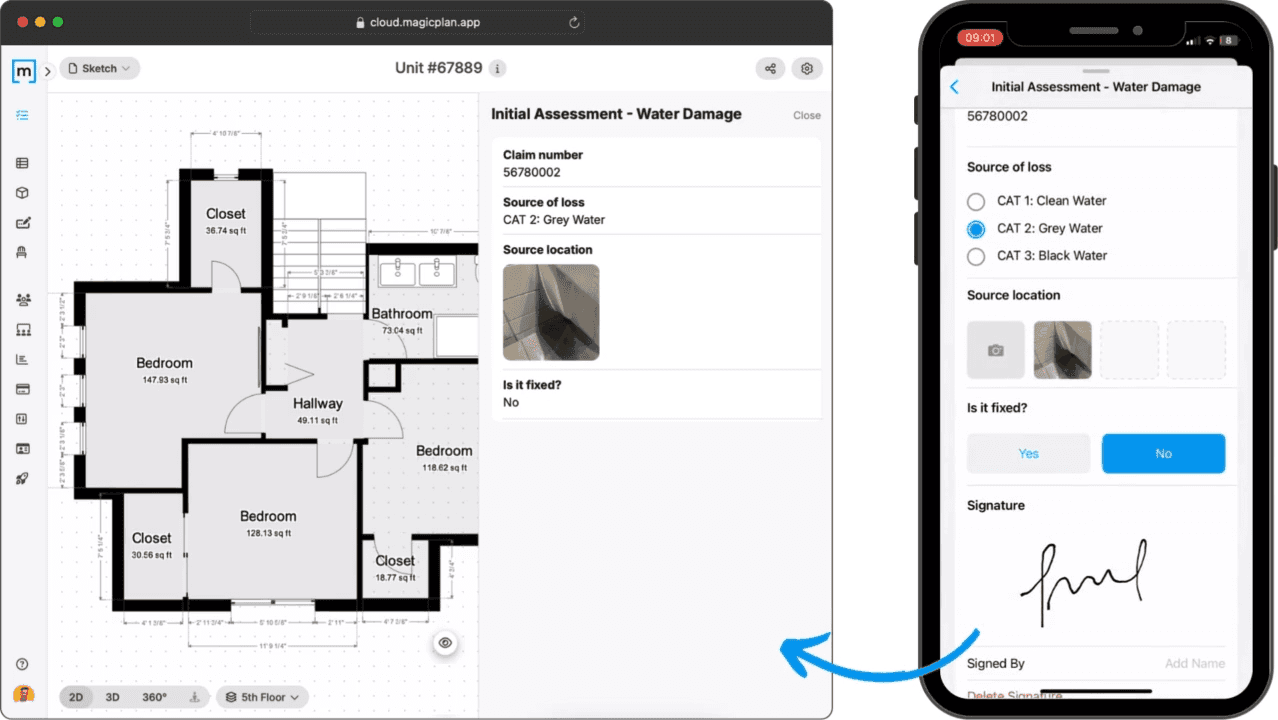
A high-quality floor plan app, such as magicplan, is an effective and efficient type of water damage software.
It will enable you to:
Create a custom form or checklist for initial water damage assessment visits
Sketch each job site’s water-affected rooms digitally in real time
Use comprehensive, built-in documentation features (360-degree panoramas, images of water damage, descriptive notes, etc.) to describe the extent of water damage and identify the proper water category
Create and share a digital water damage assessment report with others to enable a unified understanding, and to have them comment on and confirm the proper categorization
The collaborative aspect is particularly beneficial when dealing with complex water-damage projects. In those situations, multiple experts may need to contribute their insights to ensure a thorough and accurate assessment. A floor plan app makes that process quick and seamless.
Follow the S500 Standard Guidelines
These guidelines provide a comprehensive framework for water damage restoration, ad outline the best practices for each category. Strict adherence to these guidelines is crucial for achieving successful restoration outcomes while safeguarding the health and well-being of all parties involved.
Conclusion
Understanding the differences between water Categories 2 and 3 is essential for success as a restoration contractor. When you are armed with this knowledge – as well as a good floor plan app – you’ll be prepared to categorize water quickly and correctly.
SOME RELATED ARTICLES:
Share

Benjamin Brown
Director of Sales Acquisition