Three Ways to Create IAQ Inspection Reports
Restoration
4 min read
If you are in the business of performing IAQ inspections, you already have experience producing reports. And you know how much your customers rely on those reports to ensure they have healthy homes. But do you ever wonder if you are using the best method for report development? This article touches on the purpose of a report and what it should contain. Then it dives into three report-development options, to help you choose the most beneficial approach.
The Purpose of an IAQ Report
This type of report serves to summarize key findings and prescribe recommendations for improving indoor air quality.
What an IAQ Inspection Report Should Contain
That depends on the type of indoor air quality inspection you are conducting. If you are summarizing a residential or small-business inspection, you probably can keep the content concise and only a few pages in length. On the other hand, if you are creating a report for a large commercial, industrial or municipal building, the content is likely to be extensive and will fill a large number of pages.
Various Methods of Creating Reports
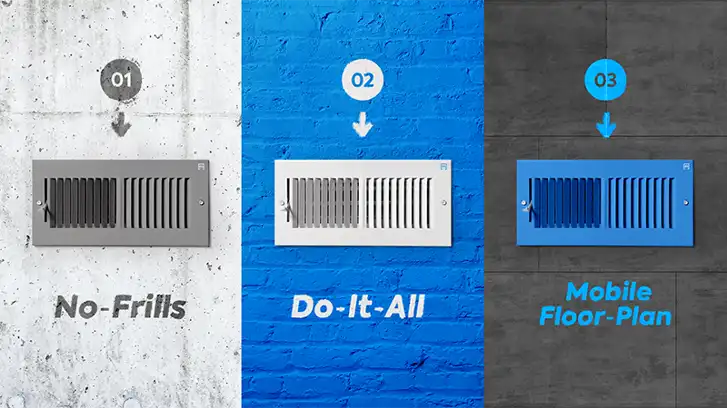
Essentially, you have three different approaches to consider:
The Basic, No-Frills Method
The Advanced, Do-It-All Method
The Happy-Medium, Mobile-Floor-Plan Method
Let’s look at those individually.
1. The Basic, No-Frills Method
What You Need:
A laptop or desktop computer
Word-processing software (e.g., Microsoft Word)
Software Cost:
This method to create reports for indoor air quality checks will cost zero dollars if you already have word-processing software installed on your business computer. If not, you have options: buy software outright by paying a relatively economical, one-time fee, or choose to subscribe and pay ongoing, monthly subscription fees.
Advantages:
You’re probably already comfortable producing written documents
You can insert basic extras that you think will be helpful (such as photos you take during inspections, or do-it-yourself tables you create with your word-processing software)
Disadvantages:No easy-to-use, baseline report template (you have to create your own from scratch)
No ability to generate and present a report immediately, at the end of each inspection (because a computer-generated report takes time to complete… and that step is better suited for your home or business office)
Key Takeaways:
The Basic, No-Frills Method is ideal if:
You actually enjoy spending a lot of time creating reports
You’ve been doing it this way for a while and you don’t feel comfortable trying something new
2. The Advanced, Do-It-All Method
What you need:
A laptop or desktop computer
Full-featured, IAQ-specific reporting software
Software Cost:
This may be an upfront purchase price of several hundred dollars, or perhaps a monthly subscription fee.
Advantages:
All kinds of software “bells and whistles” that allow you to do things such as:
Select from a list of pre-defined, plug-and-play report elements
Pull in extensive tech info (such as government and industry guidelines) to include for each inspection parameter
Choose from and edit canned text blocks
Create and insert graphs, from a menu of predetermined style
Disadvantages:
Necessitates hours of self-training time to become familiar with all of the different features
Requires practice to become skilled at using all of the different features
May be way more complicated than what you need – and that can be a downfall if it means report drafting is too complex and takes up too much of your time
Does not give you the ability to generate and present a field report immediately, at the end of each inspection (because a computer-generated report takes time to complete… and that step is better suited for your home or business office)
Key Takeaways:
The Advanced, Do-It-All Method is ideal if:
You typically perform inspections for large commercial, industrial or municipal buildings
You intend to perform multiple types of indoor air quality testing onsite
You often must wait for extensive lab results, and then spend time analyzing and interpreting those results, before you complete and submit your inspection reports
You intend to produce (and your customers expect) extensive and lengthy reports
3. The Happy-Medium, Mobile Floor-Plan Method
What You Need:
A mobile phone or tablet
A mobile data plan (if you want to be able to email reports from the field and store reports in the cloud)
A floor-plan sketching and reporting software application that automates the sketch creation process and has built-in reporting capabilities
Software Cost:
Most likely, this will be a monthly or annual subscription fee, with different pricing tiers available (i.e., the more features/capabilities you choose to use, the higher the fee).
Advantages:
A high-quality floor-plan app will allow you to build your report for IAQ assessments speedily, in real time, as you move through an inspection. Here’s how you do it:
Connect a Bluetooth digital tape measure, and use the app to collect room measurements and create a scaled floor plan quickly
Easily convert the floor plan into a baseline report document
Enhance the floor plan by adding room features and objects
Quickly authenticate your findings by adding photos for emphasis and clarity
Add notes and markups to record details on the go
Share your report and discuss it with your customer before you leave
Disadvantages:
Does not provide the advanced functionality needed for complex reports about large commercial, industrial and municipal buildings
If you want full Internet access, this method requires a monthly fee for a mobile data plan (which is a non-issue if you already have one)
Read more: 5 Reasons to Create a Floor Plan Sketch During an IAQ Inspection
Key Takeaways:
The Happy-Medium, Mobile Floor-Plan Method is ideal if:
You want to use software that is designed to streamline the reporting process
You normally perform inspections of smaller structures (residential homes, small businesses)
You typically do not perform a lot of IAQ testing that requires lab analysis
You don’t plan to include graphs and tables in your reports
You intend to produce concise reports that are just a few pages in length
You like the idea of creating a report onsite, as you perform each inspection (instead of investing time later, at your office)
You like the idea of presenting and discussing a report at the end of each inspection, to help the customer immediately, provide closure, and be able to invoice the inspection sooner
Conclusion
Report development is an important part of your IAQ inspection business. By taking time to evaluate different methods for producing reports, you’re sure to find the one approach that suits you the best.
Share
The Purpose of an IAQ Report
What an IAQ Inspection Report Should Contain
Various Methods of Creating Reports
1. The Basic, No-Frills Method
2. The Advanced, Do-It-All Method
3. The Happy-Medium, Mobile Floor-Plan Method
Conclusion

Bernd Wolfram
CPO