How BELFOR Uses magicplan to Tackle Restoration Challenges
Project Documentation
5 min read
Challenge
Capturing, documenting, and storing damage information
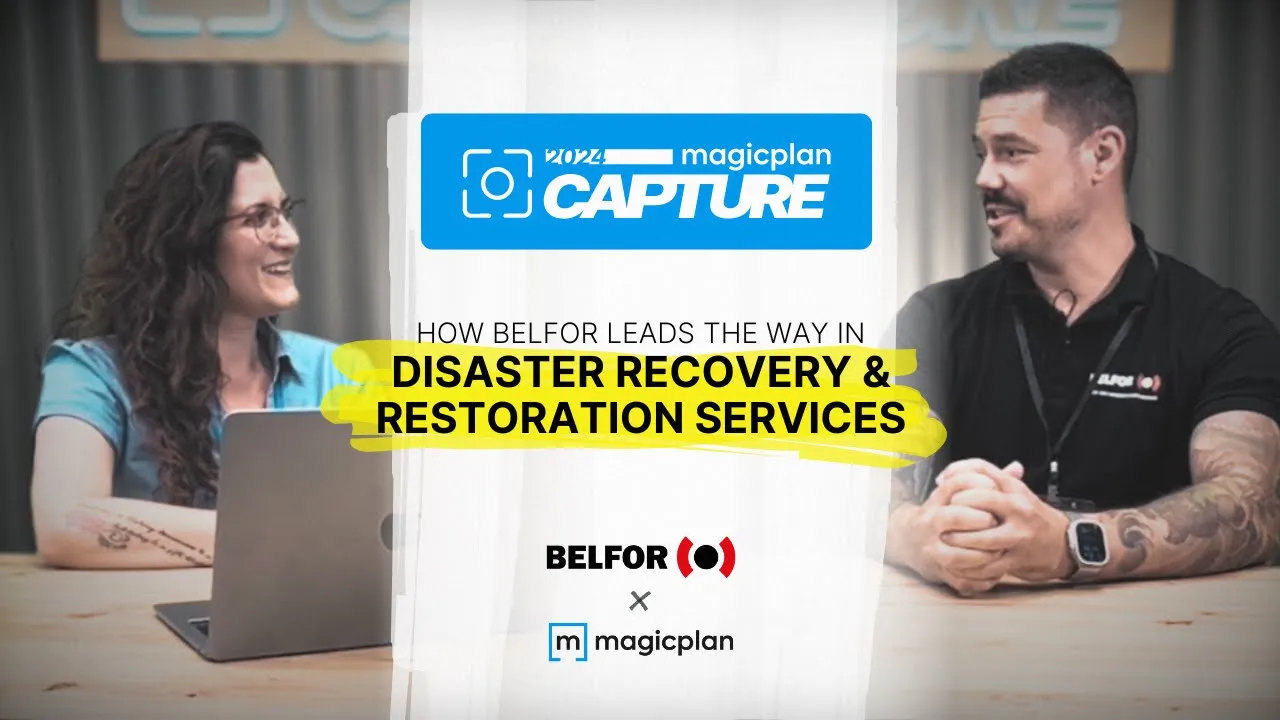
Florian explains that one of the central challenges in restoration work is the complex capture of damage-related data. This includes documenting the damage and ensuring that all related information is stored and archived in one place. He emphasizes that damage documentation involves more than just a single task, as it requires collecting different types of information and making sure everything remains accessible afterward.
He describes the importance of having damage data, documentation, and storage combined in a structured way, rather than being spread across different tools or systems.
Solution
Using magicplan in daily project work
Florian states that BELFOR has been using magicplan since 2012. He explains that project managers are the primary users of the app. He notes that in cases where a customer already provides a floor plan, magicplan may not be used, but in general, project managers regularly work with it.
He explains that magicplan is used to create floor plans, add objects, and attach photos. He describes how drawing, placing objects, and taking pictures are all part of the same workflow. He also explains that magicplan is connected through an interface to BELFOR’s internal systems.
When a project manager finishes work in magicplan and closes a project, the data is transferred automatically into BELFOR’s internal storage system.
Results
Automatic transfer of project data
Florian explains that once a project is completed in magicplan, it is automatically transferred into BELFOR’s internal storage. This means that when the project manager closes the project, the data is saved directly on the company’s server.
He explains that this automatic transfer ensures that all relevant information from the project is stored centrally and can be accessed internally without additional manual steps.
Outlook
Onboarding process and measurement approach
Florian explains that onboarding differs by location. Using Berlin as an example, he describes an onboarding process for new project managers that lasts approximately six months. During the first three months, new employees accompany experienced colleagues and observe their work. After that, they receive internal training, either from another project manager or directly from Florian. He describes the process as learning by doing.
Florian also explains BELFOR’s preferred approach to measuring rooms. Because many employees use Android devices, BELFOR primarily relies on laser measuring devices. He explains that laser measurements provide precise dimensions and can be synchronized with tablets, which allows measurements to be captured more efficiently.