How to Choose the Right Moisture Meter for Restoration Work
Restauration
6 min read
Moisture is a constant, relentless adversary in restoration. Whether you’re battling the aftermath of flooding, a burst pipe, or everyday humidity, you already know that accuracy in moisture detection means faster mitigation, fewer callbacks, and credible documentation in the eyes of clients and adjusters. But choosing the right moisture meter isn’t just about ticking boxes on a spec sheet. It’s about giving yourself the power to tackle a broad range of scenarios with confidence and precision, day after day.
Understanding Meter Types — and When to Use Them
Three main categories of moisture meters are used in professional restoration: pin-type, pinless, and combination models. Each type excels in specific environments and applications, making it critical to match your meter to the job.
PIN-TYPE METERS use two metal probes that penetrate surfaces such as wood, drywall, or subflooring to measure electrical resistance — a reliable indicator of moisture deep within the material. These meters deliver highly accurate, quantitative readings and are especially favored for verifying drying progress in structural elements. However, they can be slower for surveys of large spaces. Also, they do leave small marks, making them less ideal for finished surfaces where the goal is minimal disruption.
PINLESS METERS, by contrast, employ sensors to scan moisture levels below the surface without any penetration. This technology allows you to quickly sweep large areas, identify damp spots for follow-up testing, and avoid leaving any physical evidence of testing. Pinless meters are particularly useful when assessing broad surfaces such as walls, ceilings, and floors — for example, during the initial stages of water intrusion investigation or when documenting ongoing drying in sensitive settings. Pinless meters also are ideal for taking measurements in places not easily accessible, such as behind a tiled wall or floor. However, they are not able to detect exactly how deep the moisture goes.
COMBINATION METERS merge both pin and pinless capabilities, offering unparalleled adaptability. If you’re managing crews and want to ensure everyone has the right tool for every scenario, these all-in-one models provide seamless transitions between surface and core readings, helping to simplify workflows and minimizing the need for multiple devices. However, these meters typically come at a higher upfront cost.
Practical Restoration Scenarios — Different Reasons to Use Meters
Day-to-day, you’ll find yourself using moisture meters to:
Establish the initial scope of damage by conducting a moisture inspection — i.e., comparing readings in affected and unaffected zones (and capturing both surface and structural moisture readings).
Track moisture control drying progress and inform adjustments in equipment staging, such as dehumidifier placement and air mover output.
Verify materials have reached “dry standard,” typically derived from baseline readings before intrusion.
Satisfy insurance requirements for photographic documentation, geotagged readings, and time-stamped dry logs for water mitigation evidence.
READ MORE: How to Document Moisture Points Like a Pro
What’s Available Now — Examples of Popular Moisture Meters
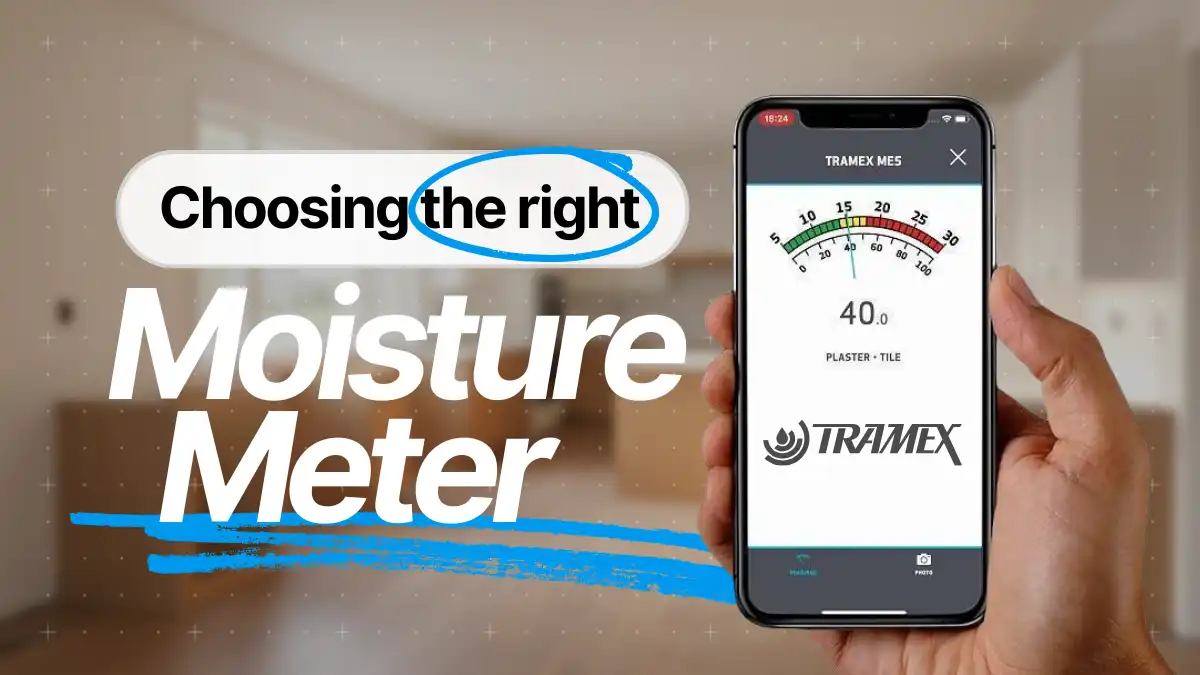
Many restoration pros rely on current models like the Tramex ME5 and the Tramex CMEX5. Both deliver robust performance, accuracy, and digital integration, making them ideal companions for today’s restoration challenges. Their reliability and user-friendly features help ensure no moisture pocket is missed, and that documentation — manual or automated — remains thorough and defensible.
Take a closer look:
The Tramex Moisture Encounter ME5 performs pinless scanning to help you cover more ground more quickly, and with minimal effort. This meter has a Duel Depth features that enables both shallow-depth and deep-depth readings, making it possible to determine where the moisture is located within the materials you are measuring.

The Tramex Moisture Encounter CMEX5 is able to tackle tough substrates, such as concrete floors and slabs, as well as wood and other building materials. It also features a built-in Hydrometer that measures Ambient Relative Humidity, Temperature, Dew Point, and Humidity Ratio (or Mixing Ratio) of the environment.

The Science Behind the Reading — A Primer on Psychrometrics
Understanding psychrometrics is key to interpreting moisture readings accurately and optimizing drying strategies. Simply put, psychrometrics is the study of air’s moisture content and how temperature, humidity, and vapor pressure influence evaporation. For restoration, practical psychrometrics comes down to these fundamentals:
Relative humidity (RH): Measures how saturated the air is. High RH slows drying since the air absorbs less evaporated moisture.
Temperature: Warmer air can hold more moisture, helping speed up the drying process by promoting faster evaporation, when managed effectively.
Dew point: The temperature at which air becomes fully saturated with moisture, so that condensation forms. Keeping spaces below this point helps prevent condensation damage and future mold concerns.
Psychrometric chart: Presents properties of air in a graphical format, and is used to visualize and control environmental conditions, ensuring faster, more reliable drying with less risk of secondary damage.
Applying psychrometric principles in daily practice means regularly logging temperature and humidity data, analyzing how they shift alongside moisture readings, and taking control of drying conditions by adjusting equipment and site conditions accordingly.
Using Your Meter Like a Pro — Three Tips for Reliable Results
A properly chosen and maintained meter becomes an extension of your fieldwork. Follow these tips to get the most out of it:
Begin every job by establishing a “dry standard”—a baseline reading from an unaffected area. This reference point guides both drying targets and insurance documentation.
As you progress, collect readings systematically, noting time, location, and environmental conditions for each measurement.
Consistency is essential: always use the same device for ongoing checks on a project, keep readings calibrated according to manufacturer recommendations, and store results in organized logs for easy retrieval if a dispute or claim arises.
Regular maintenance is also crucial. Clean pins and sensors after every use, monitor battery levels, and keep meters stored securely between jobs.
Professional Moisture Mapping & Documentation — A Smarter Way Forward
Moisture mapping water damage is central to tracking job progress and defending your work to clients, insurers, and third-party inspectors. However, the old method — involving note-taking, manual floor diagrams, sporadic photos — can be error-prone and inefficient. Recent advances now enable restoration professionals to automate and streamline moisture map creation by using the magicplan app in tandem with a Bluetooth-enabled Tramex moisture meter.

With magicplan, readings from meters such as the Tramex ME5 and CMEX5 flow automatically into digital floor plans. Each moisture reading is matched to a location, time-stamped, and fully documented without manual transcription. It’s an automatic, fast, and easy method that helps your company maintain professional standards and streamline complex jobs.
This magicplan/Tramex integration also ensures instant access to comprehensive moisture records throughout the project lifecycle, supporting report generation, workflow clarity, and a library of records that can be referenced for future projects.
“Working efficiently has always been our focus at magicplan,“ stated Andreas Boehm, CEO at magicplan, as reported in a September 2025 Restoration Remediation article. “With this Tramex integration, we’re eliminating time-consuming tasks and making it easier to tie field data right to the plan. It’s another step toward unlocking better workflows for restoration pros.”
Wrap-Up
Moisture meters are more than diagnostic tools: They are foundational to every restoration job you manage. By selecting the right meter for each material and scenario, understanding the basics of psychrometrics, employing rigorous measurement practices, and leveraging automation for mapping and reporting, you empower your business to handle both routine and demanding restoration tasks with certainty and credibility.
Whether you’re investigating water intrusion, confirming progress of drying equipment, or providing bulletproof documentation to clients and adjusters, a trusted moisture meter— backed by sound technique and smart technology — keeps your business at the forefront of restoration excellence.
Share
Understanding Meter Types — and When to Use Them
Practical Restoration Scenarios — Different Reasons to Use Meters
What’s Available Now — Examples of Popular Moisture Meters
The Science Behind the Reading — A Primer on Psychrometrics
Using Your Meter Like a Pro — Three Tips for Reliable Results
Professional Moisture Mapping & Documentation — A Smarter Way Forward
Wrap-Up

Benjamin Brown
Director of Sales Acquisition